
Why Your AI Stumbles on Easy Questions: The Hidden Science of Chunking
Shiv Srivastava
Product Architect & Founder · AdvikPrep
Why Your AI Stumbles on Easy Questions: The Hidden Science of Chunking
Before diving into vector databases, embeddings, or retrieval algorithms, consider four common production nightmares that leave engineering teams scratching their heads:
The Four AI Paradoxes
1. The "Dump the Whole Book In" Trap New AI models can handle millions of words at once. So why can't we just paste an entire 500-page employee handbook into the chat and let the AI find the answer? What actually happens: Think of skimming a massive phone book in two minutes—you clearly remember the first page and the last page, but everything in the middle becomes a blur. AI does the exact same thing: it easily misses important facts buried on page 240. Plus, making the AI read an entire book just to answer one simple question makes it painfully slow and runs up a massive bill.
2. The "Words Taken Out of Context" Disaster Why did a workplace chatbot answer an employee's innocent question about paternity leave with: "Your account has been permanently shut down"? What actually happens: The search tool grabbed a single, lonely sentence from the handbook that happened to contain the word "leave." But that sentence was taken from the section on firing employees! Without the paragraphs around it to explain what was going on, the AI had no idea what kind of "leave" it was actually looking at.
3. The "Muddy Paint" Problem Why does an AI search engine completely miss the exact paragraph you need and bring back useless junk instead? What actually happens: Think of each topic as a pure paint color—bright blue for return policies, bright red for billing rules, bright yellow for shipping info. If you try to summarize a whole 10-page chapter all at once, it's like dumping every color into one bucket. You get a muddy brown puddle. Because the overall summary is so mixed up, the AI can't match it to any single clear topic.
4. The "Reprint the Whole Book for a Typo" Bill Why are company cloud bills through the roof when employees only fixed a couple of tiny spelling errors in their documents? What actually happens: Because the computer treats the entire document as one giant block. If someone fixes a single typo on the cover page, the system doesn't realize that 99% of the file is still identical. It reads, saves, and charges you to process the entire massive file all over again from scratch.
Every single one of these everyday headaches comes down to one missing step: breaking long text into smart, bite-sized pieces—a process known as Chunking.
1. What Is Chunking? (The Index Card Analogy)
Imagine studying for a medical board exam. You wouldn't bind every medical textbook into a 10,000-page volume and flip through it randomly during patient rounds.
Instead, you write concise index cards:
- Each card captures one discrete diagnosis, drug interaction, or procedure.
- Each card includes the topic title at the top so it makes sense in isolation.
- Each card is compact enough to read in 10 seconds.
Chunking is the computational process of creating these digital index cards from long-form documents before converting them into numbers (embeddings) and storing them in an AI's retrieval database.
2. Why Chunking Drives Real-World AI Performance
Chunking is not just text formatting; it establishes the granular resolution of your AI system.
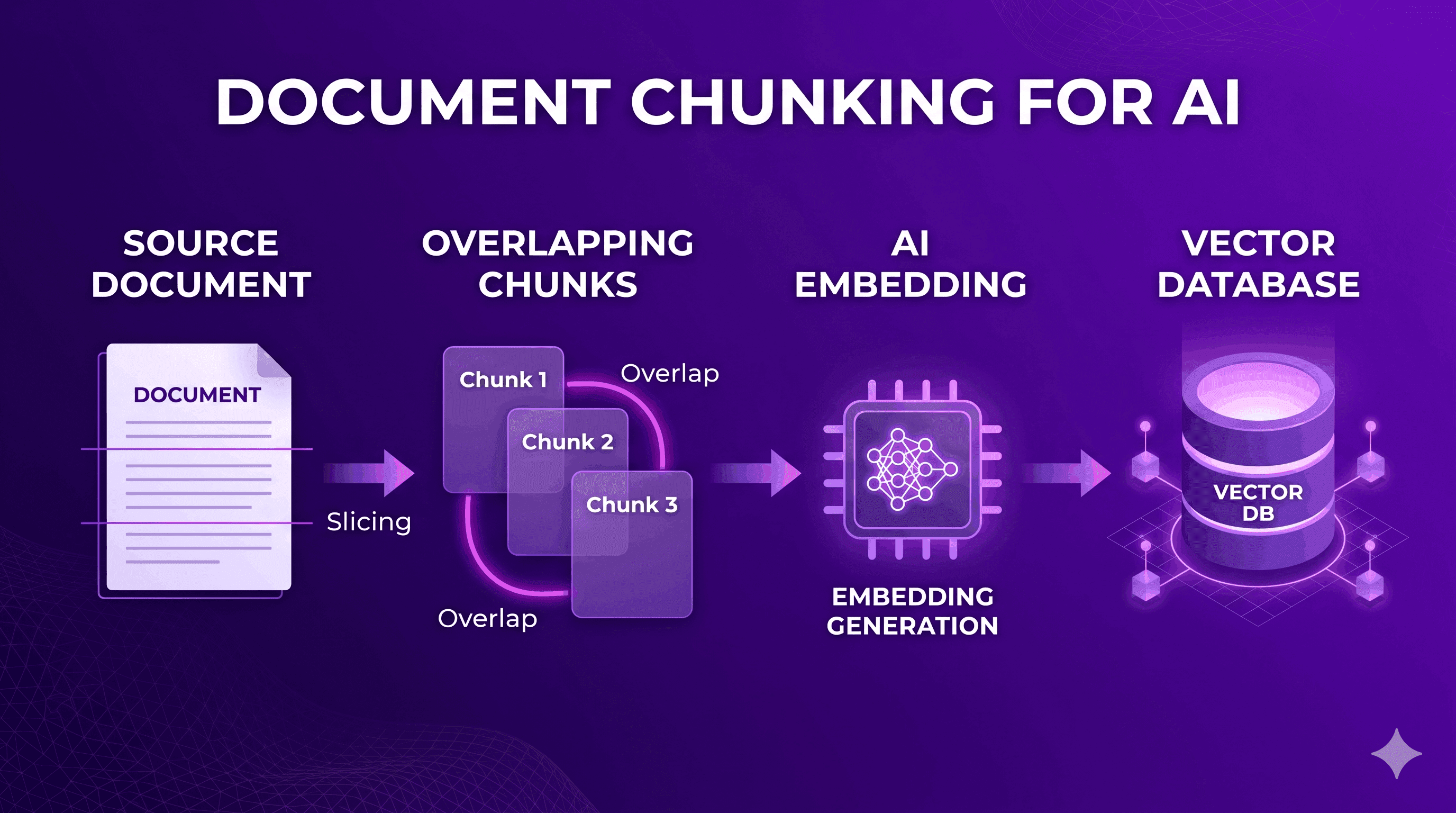
Raw Unruly Text  ──►  Chunking Engine  ──►  Discrete Chunks  ──►  Vector Store / RAG
(Noise & Chaos)        (Logic & Overlap)      (High Signal)        (Precise Answers)
Retrieval-Augmented Generation (RAG)
RAG systems retrieve facts from your database to answer user queries accurately. When chunks are compact and targeted, the retriever passes only the 200 words needed to answer the question. This lowers latency, eliminates token waste, and keeps the AI focused strictly on the facts.
Smart & Semantic Search
Keyword search scans for exact words (Ctrl + F). Semantic search maps conceptual meaning into multidimensional space. Precise chunking ensures that a query like "How do I fix a leaky pipe?" matches the exact troubleshooting subsection rather than a 50-page homeowner warranty agreement.
Semantic Clustering & Document Organization
When categorizing thousands of legal contracts or research papers, chunk-level clustering detects that Clause 4.2 in Contract A serves the exact same legal intent as Section 11 in Contract B, even if the overarching agreements cover completely different commercial transactions.
Recommendation Systems
Recommending a 40-minute podcast or a 30-page whitepaper based on a reader's interest in a niche topic (e.g., "PostgreSQL indexing strategies") is frustrating if that topic is only mentioned for 30 seconds. Chunk-level analysis pinpoints the exact timestamp or paragraph that matches user intent.
Duplicate Detection
Plagiarism scanners and storage-deduplication systems rely on deterministic hashing of chunks. When a user updates one sentence in a handbook, chunk hashing ensures only that single modified block is updated in the vector store, saving compute and storage costs.
3. The Goldilocks Dilemma: Size, Noise, and Overlap
Finding the ideal chunk configuration requires balancing two opposing trade-offs:
[ Too Small: Loss of Context ]  <─── [ Balanced: Clear Focus ] ───>  [ Too Big: Dilution & Noise ]
  "He approved the budget."             "Q3 Budget: John approved        Entire financial audit report:
  (Who is 'he'? Which budget?)          $50k for marketing on July 1."   Retriever matches wrong years.
- Too Small (e.g., 50–100 characters): The text loses referential integrity. Pronouns like "it", "he", or "they" lose their antecedents.
- Too Big (e.g., 4,000+ characters): The chunk introduces semantic noise. The vector is too broad, and irrelevant sentences pollute the LLM's prompt window.
- The Role of Sliding Overlap: If a chunk boundary cuts off halfway through a critical sentence, the thought is severed. Overlap duplicates the tail end of Chunk 1 at the beginning of Chunk 2, ensuring no critical detail is lost at the seam.
4. Production Code: Helper Functions & Chunking Strategies
Below is an enterprise-grade TypeScript implementation showcasing three progressive approaches to chunking, complete with data normalization and deterministic hashing.
The Foundation: Normalization & Hashing
Raw text extracted from PDFs, databases, or web scrapers contains inconsistent line breaks and no tracking IDs. These helpers establish a clean baseline:
import { createHash } from "node:crypto";

/**
 * Generates a unique, deterministic 16-character SHA-1 hash for any text chunk.
 * Essential for deduplication, idempotent database upserts, and vector caching.
 */
export const chunkId = (text: string): string => {
  return createHash('sha1').update(text).digest('hex').slice(0, 16);
};

/**
 * Normalizes line endings across operating systems by converting Windows-style
 * carriage returns (\r\n) into Unix line feeds (\n).
 */
export const clean = (t: string): string => t.replace(/\r\n/g, '\n');
Strategy A: Fixed-Size with Sliding Overlap (fixedChunks)
- How it works: Slices text into rigid character windows (default 500 characters) and steps forward by
size - overlap(default 400 characters). - When to use: Ingesting unstructured text dumps, machine logs, OCR outputs, or documents lacking formatting structure.
export function fixedChunks(text: string, size = 500, overlap = 100): string[] {
  if (overlap >= size) {
    throw new Error('Overlap must be smaller than chunk size');
  }

  const t = clean(text);
  const out: string[] = [];

  for (let i = 0; i < t.length; i += size - overlap) {
    const piece = t.slice(i, i + size).trim();
    if (piece) {
      out.push(piece);
    }
    // Prevent redundant trailing slices
    if (i + size >= t.length) {
      break;
    }
  }
  return out;
}
Strategy B: Paragraph-Aware Chunking (paragraphChunks)
- How it works: Respects structural document flow by grouping whole paragraphs (
\n\n) until reaching a size threshold (default 600 characters). - Smart Fallback: If a single paragraph is unusually long and exceeds the maximum limit, it safely drops down to
fixedChunksto avoid dropping data. - When to use: Articles, blog posts, essays, and reports written in natural prose.
export function paragraphChunks(text: string, max = 600): string[] {
  const paras = clean(text)
    .split(/\n\s*\n/)
    .map((p) => p.trim())
    .filter(Boolean);

  const out: string[] = [];
  let cur = '';

  for (const p of paras) {
    // Condition 1: An isolated paragraph exceeds the maximum size ceiling
    if (p.length > max) {
      if (cur) out.push(cur);
      cur = '';
      out.push(...fixedChunks(p, max, Math.floor(max / 5)));
    }
    // Condition 2: Appending this paragraph would breach the size ceiling
    else if (cur && (cur + '\n\n' + p).length > max) {
      out.push(cur);
      cur = p;
    }
    // Condition 3: Accumulate into current buffer
    else {
      cur = cur ? cur + '\n\n' + p : p;
    }
  }

  if (cur) out.push(cur);
  return out;
}
Strategy C: Markdown Heading-Aware Chunking (headingChunks)
- How it works: Tailored for structured documentation. It tracks Markdown headings (
#,##,###), retains all body text under each section, and prepends the parent heading to every chunk produced within that section. - Why context repetition matters: A chunk that simply reads "Run
npm run build" is ambiguous. Prepending# Production Deployment > Web Servicegives the embedding model and the retriever the exact scope needed to answer accurately. - When to use: Technical wikis, API references, GitBooks, and corporate knowledge bases.
export function headingChunks(md: string, max = 800): string[] {
  const out: string[] = [];
  let heading = '';
  let body: string[] = [];

  const flush = () => {
    const text = body.join('\n').trim();
    if (text) {
      for (const c of paragraphChunks(text, max)) {
        // Prepend the active heading to provide local scope
        out.push(heading ? `${heading}\n${c}` : c);
      }
    }
    body = [];
  };

  for (const line of clean(md).split('\n')) {
    if (/^#{1,3}\s/.test(line)) {
      flush();
      heading = line.trim();
    } else {
      body.push(line);
    }
  }

  flush();
  return out;
}
5. Architectural Comparison Matrix
| Strategy | Splitting Anchor | Context Quality | Ideal Domain | Main Trade-Off |
|---|---|---|---|---|
fixedChunks | Character offset | Low – Medium | Raw text, OCR logs, code dumps | Can bisect sentences and words |
paragraphChunks | Double line breaks (\n\n) | Medium – High | Articles, essays, manuals | Drops overarching document titles |
headingChunks | Headers (#, ##) + Paragraphs | Very High | Technical wikis, Markdown docs | Relies entirely on consistent Markdown |
6. Critical Edge Cases in Production
Before deploying a chunking pipeline to production, account for these common structural pitfalls:
- Tables and Structured Grids: Slicing a Markdown or HTML table horizontally leaves rows severed from their column titles. In a RAG pipeline, a row reading
| $12,000 | Pending Approval |is meaningless without knowing whether it belongs to "Travel Expenses" or "Capital Expenditure."
- Solution: Keep small tables intact as atomic chunks, or inject table headers into every subdivided row chunk.
- Code Blocks & Syntactic Structures: Slicing halfway through a JSON payload or Python function produces broken syntax that can confuse an LLM tasked with code analysis.
- Solution: Detect fenced code blocks (`````) and preserve them as single blocks wherever possible.
- Character Count vs. Token Count: The implementations above use character counts for speed and cross-runtime compatibility. However, LLMs calculate limits based on tokens (typically ~4 characters per token in English, but significantly more characters per token in languages like Japanese, Arabic, or Hindi). For multilingual deployments, calculate boundaries using a tokenizer like
tiktoken. - Lists and Nested Items: Splitting a 20-step procedure across multiple chunks can detach child items from the parent prompt (e.g., "Step 8: Turn off the main switch" without the introductory warning "Before servicing the circuit breaker:").
7. End-to-End Pipeline Demonstration
Here is how these functions work together to prepare content for a vector database:
const markdownDocumentation = `
# Infrastructure Handbook

## Database Maintenance
Production databases undergo routine maintenance every Sunday at 02:00 UTC.
Connections will experience a brief failover window lasting under 30 seconds.

Always verify read-replica replication lag before initiating schema migrations.
Ensure you have an active automated snapshot taken within the last 4 hours.
`;

// 1. Process document into context-aware chunks
const chunks = headingChunks(markdownDocumentation, 250);

// 2. Prepare items for database upsert with deterministic IDs
const indexedRecords = chunks.map((chunk) => ({
  id: chunkId(chunk),
  content: chunk,
  charLength: chunk.length,
}));

console.log(indexedRecords);
By transitioning from naive full-text ingestion to intentional, structure-aware chunking, you solve retrieval ambiguity at the root—ensuring your search and generative AI systems remain fast, cost-effective, and accurate.
Ready to try AdvikPrep?
Practice with expert-curated exam sets, instant grading, and AI-driven insights. Free to start — no credit card required.